
Archive for the ‘nostalgia’ Category
This is Cinerama
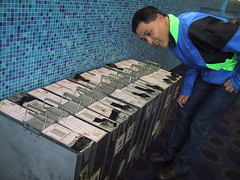
My brother and 70MM Lawrence of Arabia
This Friday the Seattle Cinerama begins a two and a half week 70MM and Cinerama film festival. The theater’s curved and impressively wide Cinerama screen will be used for all showings. Greg Wood tracked down several 70MM classics including “2001: A Space Odyssey”, “Cleopatra”, and “My Fair Lady”. A few years ago at a similar event, I saw “This Is Cinerama” there with all 3 projectors going. “Lawrence of Arabia” in 70MM had just been delivered to the theater from Sony Pictures by FedEx and so I snapped a photo of the 13 large containers sitting in the lobby. The festival is a unique opportunity to truly see the widescreen movie experience as it was before theaters were crammed down into sizes that makes one want to just wait for home television viewing.
Toy Hall of Fame
The National Toy Hall of Fame, one of the collections of The Strong educational institution in Rochester, NY, has announced 12 finalists for this year’s two spots. The contenders are: dollhouse, Dungeons & Dragons, Hot Wheels, Jenga, Pogo Stick, puppets, R/C vehicles, Rubik’s Cube, Simon, Star Wars action figures, Transformers, and Twister. The finalists will be announced in November. You can submit a story about your favorite of the 12 on their site. Perhaps the oldest toy, the stick, was inducted in 2008. The Nintendo Game Boy was inducted a year later, the Atari 2600 a year earlier.
Food Trucks of the 1890s
As the food truck trend spreads across America, the L.A. Times takes us back to the late 1800s when tamale wagons served customers on the streets of Los Angeles. They’re the forerunners of today’s taco trucks (loncheras), powered by horses instead of gasoline. There were over 100 of them by 1901 and some deemed them unsafe as they supposedly gathered a bad crowd, especially after the saloons closed. But they perservered as fans of Mexican food grew and now their descendants are everywhere, even, some might say, in the spirit, though not the flavor, of the Taco Bell on the corner.
Quick Mac Nostalgia Break
After reading Caroline McCarthy’s tweet about the Oscar the Grouch Mac extension I wanted to see it again too. YouTube to the rescue:
The authors: Eric Shapiro and Ken Hornak (graphics). I don’t think I used this for long since it got old quick, but thinking about it now, as Caroline said, does make me smile.
Typewriters in India
The typewriter age hangs on in India where bureaucracy (meaning paperwork in triplicate) has not moved entirely onto computers. “Sometimes the monkeys steal the affidavits,” says a typist outside the Delhi District Court. Even several Indian governments that have adopted computers still require a manual typing test for jobs. So the typewriter repair stores and typing classes linger on. India’s Godrej & Boyce, the last typewriter factory in the world, shut down its last production line after the financial downturn accelerated the decline of orders. When the electricity goes out, as it often does in India, the bureaucrats keep on typing.
Careers the board game
My parents still have our old board games. I went through them recently and will be writing about a few. My favorite of the bunch is Careers. That’s our copy above on the left with the masking tape. It never achieved the popularity of Monopoly or Life and very few people I’ve mentioned it to have heard of it. When I went searching for Careers fans on the Internet I found two write-ups, both from players who had discovered it recently. One researched different versions of the game as it was updated through the years. The other, over on ReadyMade, actually got in contact with the daughter of James Cooke Brown, the creator of Careers. Turns out he lived the philosophy of his game in real life. Careers, you see, is aptly pluralized as you move around the board trying different career paths to gather fame, fortune, and happiness points to meet your 60 point Success Formula, the sum of all 3 allocated by your preference. You might go into business and politics and become a movie star. In the different versions of the game you might become a farmer, a teacher, a uranium prospector, an astronaut, and sit on park bench or in the unemployment office. You might enjoy, as I did, getting stuck on the stock market square, buying stock and rolling a die hoping for a big profit (in my memory it was the “gambling career” square). James Cooke Brown had several careers and interests himself. He was a statistician, professor of sociology, wrote science fiction, and invented Loglan. He programmed a university computer to play Careers and analyze the different formulas and he catalogued completed score cards that players sent in for replacements. The goal of Careers is not to stay in one field but to do many things in your life to achieve your own Success Formula.
Muppet Season
The new Muppet Movie, called The Muppets, opens in November and the tie-in publicity is gearing up. Out on August 23rd “Muppets: The Green Album” contains 12 covers of popular Muppet songs by a variety of artists. Amy Lee (of Evanescence) sings a nice version of Robin the Frog’s sweet gem “Halfway Down the Stairs” (Robin’s version on YouTube) based on the A.A. Milne poem. NPR has the entire album available to stream online right now. Not exactly related to the upcoming movie, the San Francisco Chronicle ran a piece on Henson Alternative, the adult-oriented arm (ha!) of the Jim Henson Company. They’ve been doing puppet improv, partnering with a Groundlings improv troupe instructor to bring an ad-libbed live show to adult audiences. Their group, called the Miskreant Puppets, is performing “Stuffed and Unstrung” in San Francisco this month. I guess they didn’t want “Avenue Q” to have all the mature fun. But to really feel our age, let’s go back to 1979 for the original Muppet Movie theatrical trailer.
Happy 30th Birthday MTV
It hasn’t been the same since reality TV took over, but we can remember the time when MTV felt like this 30 years ago.
Copyright Berkeley Breathed, used without any permission whatsoever
It’s Daniel’s Neighborhood Now
They can’t bring back Mister Rogers but they are carrying on his Neighborhood of Make Believe in a new series. PBS has announced the animated series “Daniel Tiger’s Neighborhood” which features the same characters from the original show all grown up with their own preschool-aged kids. Title character Daniel is actually the four-year-old son of the first Daniel the Tiger. He’ll talk directly to the TV audience, just like Fred Rogers did, though nowadays kids are used to that technique used in many other shows. The main puppet characters had all been voiced by Fred Rogers himself. I’m curious to see who else will make an appearance in the new series. Will cranky Lady Elaine Fairchilde or her offspring fill the antagonist role again? Will Henrietta Pussycat’s kid have a larger vocabulary than her mostly meows? And is the Neighborhood of Make Believe still a monarchy? The show starts in Fall of 2012 so we’ll have to wait a year to find out.
Two California Lighthouses
On Monterey Peninsula and in Big Sur, California, two historic lighthouses stand 25 miles apart. Both are open to visitors. The more accessible of the two, Point Pinos Lighthouse near Monterey, first shone in 1855 and claims the title “Oldest Continuously-Operating Lighthouse on the West Coast.” Its original whale oil lantern has been upgraded over the years and now a 1000 watt lightbulb is fronted by the prisms of a third order Fresnel lens. Volunteers serve as lighthouse keepers and give tours. Point Sur Lighthouse sits on a large volcanic rock where it has guided ships since 1889. A spot on the 3 hour tour is required to gain access. As with many lighthouses operating nowadays, an aero-beacon (similar to the automatic lights used to warn aircraft away from towers) has taken the place of its first-order Fresnel lens (which is in the collection of the Museum of Monterey).