
Archive for the ‘nostalgia’ Category
Typewriter Repairmen (Last)
Seems you can’t be a typewriter repairman without someone sticking “last” in front of your title. But there are still a few “last” typewriter repairmen ready to service your Selectric. The Seattle Times found Robert Montgomery in Bremerton, WA and Dave Armstrong in Bellevue, WA. Montgomery, aged 92, fixes your antique or your electric for $48 an hour at Bremerton Office Machine Co. He repaired typewriters in London during World War II. Armstrong says typewriter repair is only 10% of his business at more appropriately named Computer & Printer Repair. I plan to get rid of my electric typewriter, but I’m keeping my manual… right next to the anvil.
Living Computer Museum
I have this joke that Paul Allen has these huge garages where he puts the things he collects and when one fills up he opens a museum for it. That got us the Experience Music Project, Science Fiction Museum, Flying Heritage Collection, and, OK, the Seattle Cinerama never fit in a garage but it counts in spirit. Now Allen has opened the Living Computer Museum. “Living” because it’s not a bunch of dead boxes on display with unpowered CPUs. The computers are powered on, to a huge electricity bill, but a wonderful trip to the near past. Use a working Xerox Alto, write that infinite GOTO BASIC program again on the TRS-80, and look at the innards of a PDP 8. Photos and a trip report on Seattle Retro Gamer. AP article.
Coca-Cola for 5 cents
Coca-Cola cost a nickel for 70 years because of a short-sighted deal that gave two lawyers the rights to bottle Coke and buy syrup at a fixed price forever. When bottled Coke took off, the Coca-Cola company massively advertised 5 cent Cokes to sell as much syrup as possible. They wouldn’t get more money if the price rose anyway so they decided to push selling as much Coke as possible at that great price. Then vending machines built to take a nickel became another sticking point for raising the price. Raising it to a dime was too much, and the U.S. Treasury wouldn’t make a 7.5-cent coin. Eventually, inflation and a re-signed bottling contract made way for higher prices. But 70 years is a long time for 5 cents.
Peter Gabriel Talks at Google
In Peter Gabriel’s talk at Google he explains to the digital generation audience why “In Your Eyes” couldn’t go at the end of the original vinyl “So” album as he wished. It’s a lesson in a different type of technical limitation.
It has a good bass line there. To get a fat bass line on a full vinyl record you can’t put it near the end. You had to have it nearer the beginning. So it went on the start of side two just because there wasn’t enough room for the needle to vibrate as it got closer to the center. So then when CDs came along I was able to take that track and put it on the end where it always should have been.
Bevin Bell Factory Fire
In December 2010 I posted about the Bevin Brothers bell factory in Connecticut, last of its kind in the United States. Alas the East Hampton, CT factory burned down on Saturday. The factory was built in the 1880s. In the past there were over 30 bell factories in the area, which came to be known as “bell town.” Owner Matt Bevin, descended from the founding brothers, is cautiously optimistic about rebuilding but only if it is cost effective.
Live Better Electrically
We get the newspaper (emphasis on paper) delivered every morning and will likely continue to do so until it ceases to exist or someone makes a reading device that plays well with food and liquids. I realize more often nowadays that I’ve drifted into the “get off my lawn” camp of the more experienced population, and I look back to previous generational shifts for perspective. A YouTube commercial (below) from the late 1950s caught my attention as I struggled to relate to the time of its creation. The “Live Better Electrically” campaign was launched in 1956 by the electrical industry (General Electric) to encourage homeowners to use more electricity. Print ads included checklist quizzes to rank your electrical prowess by how many appliances you had plugged in (the opposite of one you might see in today’s “green” campaigns). “Live Better Electrically Medallion Homes” were built and certified with all electric kitchens, washer/dryers and electric heat (much to the dismay of today’s occupants who wish they had gas lines running to their homes, especially in the cold months). Electricity is still fundamental to our modern lifestyles, but the idea of having one’s home awarded for (over)consumption runs counter to today’s culture. Perhaps an amazing energy discovery will lead us back to a time where nobody can recall being yelled at for leaving the lights on.
Ex Libris
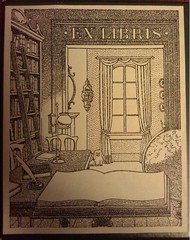
- My Laura Ashley (not custom) Bookplates
Davidson Galleries in Seattle is running an exhibition of bookplates both contemporary and antique. Over 200 of these labels of book ownership are on display including those of well-known bookplate artists (yes, they exist!) who were, not surprisingly, usually printmakers. Bookplate subjects are as varied as their owners, though of course reading-related illustrations are common. My bookplates aren’t custom but they’re Laura Ashley (how luxe!) and I’ve only used them on a few very special books. Etsy is a good place to find bookplates to match your personality. I’ve written about bookplates twice before so here are some links I’ve gathered: Confessions of a Bookplate Junkie (still going strong after 5 years), The American Society of Bookplate Collectors & Designers, The Bookplate Society, University of Notre Dame’s Bookplate Registry project, and Stanford’s online Bookplates Exhibit. There are many more bookplate resources out there and collections at many universities.
USGS Historical Topographic Maps Online
The U.S. Geological Survey started creating topographic maps in 1884. They don’t even know how many maps they’ve produced since then but they’re estimating it at 200,000. It’s such a fascinating endeavor and they’ve written papers on its history. Their National Geospatial Program is scanning all of the old topographic maps into electronic format and making them available for free download. 90,000 are available already. You can also order a reasonably priced print, the same paper format many of us are familiar with for modern USGS topographic maps (available at stores that cater to hikers like REI). The maps are in GeoPDF format, viewable in Adobe Reader and you get even more functionality with the TerraGo Toolbar extension. I downloaded Mount St Helens from 1919. Yup, it’s a lot different now. And back then the maps were all done by people hiking around taking measurements. (Here’s more geeky detail on Mount St Helens topography if you’re interested.)
Firehouses for Sale
A sliding pole? A huge garage? What attracts buyers to old firehouses? It’s not just the romanticism. Firehouses often reflect the architecture of the time they were built and since the older, historic houses are the ones usually up for sale, the draw’s in their appearance and what can be done with the interesting space. Seattle has just granted approval for two old firehouses to go up for bid. Fire Station 38 was built in 1930, Fire Station 37 in 1925. Their assessed values may not be accurate for fair market value but they provide a ballpark price for the curious. Both are historical landmarks so alterations will have to go the city’s Landmark Preservation Board. Fire Station 37 suppposedly comes with a ghost upstairs which the firefighters won’t mind leaving behind when they move into their new modern station.
General Store
At the heart of the general store is the community. Tourists may come to see the New England fall foliage and stop in to buy a souvenir but these stores may also be the local post office, coffee and donuts gathering spot, soda fountain, penny candy store. As this A.P. article points out, one of them sells guns and wedding gowns.